"In examining the hottest markets for home price appreciation, we see a rolling boom moving from one metro area to another over time, as well as a spillover effect into nearby areas with lower home prices”David Lereah is correct about the idea of a 'rolling boom. After this unprecedented housing bubble there will be significant price declines in the bubble markets. The soft landing scenario is not in the cards. A 20 - 30% inflation adjusted price declines will occur in most of the bubble markets.
“That is spreading the wealth of housing returns, with a natural easing of appreciation in areas following a period of extraordinary price growth. Even after slowing in a given area, prices typically have continued to rise faster than historic norms."
Sunday, October 09, 2005
David Lereah's Recent Statements
David Lereah, chief economist of the National Association of Realtors® recently said ( as reported by the Chattanoogan):

Friday, October 07, 2005
California Association of Realtors Antics
In a MSNBC article:
The California Association of Realtors ( CAR) has this tremendous powerpoint presentation.
Below are my favorite slides:
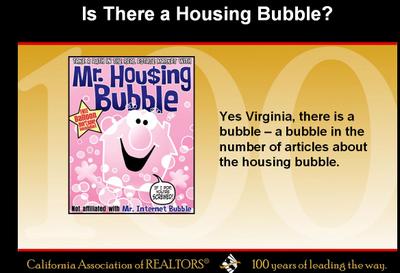
"People who cashed out three or four years ago intending to buy back in at a lower price are still waiting," says James Hamilton, president of the California Association of Realtors and manager of real-estate brokerage Re/Max Execs in Redondo Beach, California. He adds that California housing prices are expected to increase 10 percent in 2006. "If you arenÂ’t moving somewhere where the cost of living is lower, big mistake."James Hamilton is dreaming if he thinks home price appreciation will be 10% in 2006. I am willing to bet him 5 to 1 that home price appreciation in California will be less then 5% in 2006.
The California Association of Realtors ( CAR) has this tremendous powerpoint presentation.
Below are my favorite slides:

It's bubblicious. :-)
Is that froth I see emanating from the green bubble?
Key Talking Point for Bubbleheads
Here are some key Bubblehead talking points:
- There has been tremendous home price appreciation in the past 5 years in the bubble markets. Las Vegas Metro area 96%, Miami Metro Area 107%, Los Angelos Area 115% ( OFHEO Report September 1, 2005)
- The housing boom IS a speculative episode. The speculative boom will inevitably turn into a bust. Significant prices will occur in the bubble markets.
- About a third of home purchases in 2005 were either for investment or bought as second homes.
- There is no shortage of housing units. There were about 2.2 million housing units constructed last year ( US Census Bureau) and about 1.6 million are need to house a growing population and 300,00 are need to replace existing stocks that becomes uninhabitable. That leaves an extra 300,000 units.
- Inventory is rapidly increasing in the bubble markets. A significant number of home sellers have already lowered expectations in the bubble markets.
- Realtors who have not been blinded by this mania, now, know that the boom is over. ( The question for them is will it be a soft landing or hard landing.)
Thursday, October 06, 2005
Update: House in My Neighborhood
Back on September 11, I posted about a junky house in my neighborhood. In September, it was listed at 489,000 which was a reduction from the original listing price of $545,000. Now, it has been reduced again to 485,000. The MLS ID is #MC5402435 . Keep on falling. I should call the realtor and suggest a listing for 449,000.
Toll Brothers' Stock

Graph showing the stock of a leading luxury home builder: Toll Brothers. I'll let the graph speak for itself.
The Nation: 'Pop Goes the Real Estate Bubble'
Here are the highlights from The Nation article titled Pop Goes the Real Estate Bubble.
What is their source for the 13% drop in prices in Manhattan in a three month period. ? I would not call the news from the markets "unsettling news" because we need price declines in the bubble markets. The huge price appreciation that has occurred in the bubble markets has distorted the US economy. In the short term it is 'good,' but in the long term the housing bubble is damaging.
Not to mention the federal debt / deficit, the effects of offshoring, and the trade deficit. A recession is indeed coming in the next 1.5 years.
The Big One isn't the long-predicted California earthquake or even a hurricane named Katrina. The genuine big one will arrive with a deafening pop, the sound of the real estate bubble bursting.'Deafening pop' is strong language. I called it a 'loud hiss.'
In the past few years there have been plenty of false sightings, but now comes something truly ominous: a 13 percent drop in Manhattan real estate prices in a mere three-month period ending October 1.
As if that were not bad enough, more unsettling news of the same nature is reported in Boston, Washington and San Francisco, the places that have led the national upward zoom in real estate prices for the past several years.
What is their source for the 13% drop in prices in Manhattan in a three month period. ? I would not call the news from the markets "unsettling news" because we need price declines in the bubble markets. The huge price appreciation that has occurred in the bubble markets has distorted the US economy. In the short term it is 'good,' but in the long term the housing bubble is damaging.
By taking home equity loans and cashing out--that is, refinancing the mortgage--every time their houses went up in value, the millions made billions. According to Federal Reserve chairman Alan Greenspan, they made $600 billion last year on the hypothetical appreciation of their properties. That adds up to about 7 percent of their spendable, after-taxes income. That's twice as much money put into people's hands as Bush's tax cuts.Nice comparison on those big numbers. :-) $600 billion is a huge number. That is about $2000 for every man, women and child in the US.
If house prices stop going up ...add on to that what high gasoline prices are doing to the automobile industry, and most people's flat or declining incomes, and you have the makings of a fairly decent recession
Not to mention the federal debt / deficit, the effects of offshoring, and the trade deficit. A recession is indeed coming in the next 1.5 years.
Executives in the industry have sold off almost a billion dollars' worth of stock in their own companies this year, something they would not be doing if they thought the arrows were pointing upward.Great point. Big red flag as insider's have sold a huge amount of stock.
If housing does do its long-awaited plop, there are some pluses. Savings may go up, we'll buy less from foreigners and owe them less, we'll be better able to pay some of our bills.Right on. The roughly $750 billion annual trade deficit must be reduced, as it is entirely unsustainable. The end of the housing bubble will help contrinute to a shrinking of the trade deficit.
Monday, October 03, 2005
CondoFlip.com
The flippers over at CondoFlip.com want to inform us all that 'Bubbles are for Bathtubs.' CondoFlip is headquarted in Miami Beach, FL. Go Figure. CondoFlip is still under the patent pending catgory. Will CondoFlip recieve their patent before or after the bubble?
New Bubble Site Links
Some new links have been added to other housing bubble related sites on the right column of the page. Check them out.
Sunday, October 02, 2005
Home Equity Loan Rates Rising
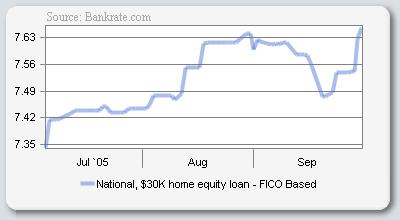
Interest rates on home equity loans are rising. The ATM machines located in many homes across Ameridebt are charging higher fees. Consumer spending will be curtailed.
Stagnation Ending, Price Declines Starting
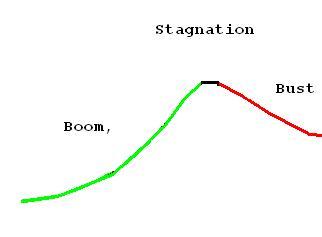
The stagnation period that was the norm in most bubble markets is no longer the norm. Small price declines are now the norm in the bubble markets. The housing boom will go bust in 2006. Price declines in most bubble markets are expected to be between 3 - 10% ( inflation adjusted) in 2006. The smart money has already exited.
There will be much pain for those who are inevitably going to be losing money. In every speculative episode those holding the bag will get burned. It won't be pretty. The housing bust has started.
Subscribe to:
Posts (Atom)

 Posts
Posts


