- Short Term Interest = Small Increase
- 30 Year Fixed Mortgages = Small Increase
- Foreclosures = Small Increase
- Lending Standards = Small Increase
- Gasoline Prices = Small Increase
- Bubble Cheerleading = Small Decrease
- Housing Inventory = Large Increase ( added)
- Housing Prices = Small Decrease
- Flipper's Happiness = Large Decrease
Wednesday, August 31, 2005
The Next Four Months
Here is how I expect things to happen in the next four months:

Jerry Howard: There is no housing bubble
It's big box office this summer in the national media, but paraphrasing Mark Twain, reports of an impending housing price collapse are greatly exaggerated.Who is Jerry Howard? Jerry Howard is executive vice president and CEO of the National Association of Home Builders.
Demographic and economic fundamentals support today's housing expansion.
To begin with, strong household formations, fueled by population growth and immigration, are pushing average annual demand for new housing into the 2 million-unit range for the decade ahead, about today's production level. Equally important, the U.S. economy is fueling enough new jobs and income gains to support brisk housing demand even as interest rates inch upward.
Second, the unusually steep price gains provoking much of the speculation over a housing bubble are mainly in California, Nevada, Florida and the Northeast corridor, and aren't the norm for most local markets.
Third, builders are running into serious obstacles, such as excessive growth controls or moratoria, in lining up land for development in the fastest growing housing markets. In the face of unrelenting housing demand, this is making housing shortages even worse, increasing the cost of building and persistently increasing house prices.
Fourth, unlike trading in stocks and bonds, buying a home is a costly and time-consuming process that is not susceptible to the kind of run on the market that occurred in the dot.com collapse. Also, the vast majority of families live in the homes they buy for a long time and don't flip them for a profit after a few months.
Finally, history shows that most unsustainable house price booms end quietly, as house price appreciation slows while ongoing increases in household income and housing supply help restore balance to local markets. A recent Federal Deposit Insurance Corp. study shows that house price booms lead to price busts only when local economies stumble for other reasons, such as a national recession. With the U.S. economy in the midst of a strong expansion, those risks are quite low for the foreseeable future.
It doesn't take a Ph.D. in economics to conclude that short supply and high demand do not add up to a housing bubble.
Tuesday, August 30, 2005
Housing Bubble Paraphanelia
About a week ago I ordered the Mr. Housing Bubble T-Shirt. But more significantly, my boss ordered for me the Mr. Housing Bubble Mousepad. I was thrilled. :-) In the office my nickname is Bubble Boy.
Fla.: FBI Says Mortgage Fraud High in the State
Here is a NAR article titled Fla.: FBI Says Mortgage Fraud High in the State
A new Financial Crimes Report from the FBI has named Florida one the nation's top 10 hot spots for mortgage fraud. The report states that such fraud is "pervasive and growing" in the state.
The most common violations include overpriced appraisals, property flipping (purchasing a home to resell at a higher price in a short time frame), and equity skimming (using a quit claim deed to sign a property over to an investor who never pays for the property).
Lydia Pisano, president of the Orlando Regional REALTORS® Association and a team leader with Keller Williams Homestead Realty in Orlando, says mortgage fraud is definitely a growing problem in the state. She credits the hot housing market with creating a breeding ground for the fraud, particularly when it comes to inflated appraisals.
"Sellers are asking a lot more for their homes than they are worth, and now we're seeing homes not appraising and price reductions," Pisano says. She adds that the trend has led lenders to tighten their review processes and to kick back inflated appraisals as unacceptable.
Pisano says some mortgage companies also are guilty of activities or carelessness that can lead to fraud. For example, "The buyers tell the mortgage company that they make $300,000 a year, and no one ever checks it," says Pisano.
Other states cited by the report as high in mortgage fraud include Georgia, South Carolina, California, Illinois, Michigan, Utah, Missouri, Nevada, and Colorado.
Homebuilders' Stock Prices Continue to Fall
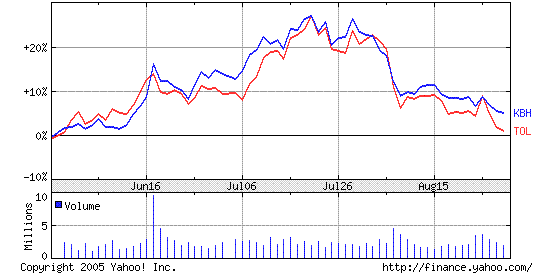
Homebuilders' stocks continue to tumble. The market knows what is coming. The bubble is about to burst.
Monday, August 29, 2005
Wise Comments
Merrill Lynch economists Kathleen Bostjancic and David Rosenberg said in a economic commentary:
"We find that the red-hot housing sector alone, which typically represents just 5% of the total economy, accounted for an astounding 50% of the overall growth in the U.S. economy by the first half of this year, and more than half of the private payroll jobs created since fall 2001 were in housing-related sectors,"
"We argue this represents an unhealthy and disproportionate share of economic growth. The overreliance on residential investment leaves the economy very vulnerable if housing demand and prices cool -- prices do not need to even fall; just a slowing in the pace of home price appreciation would have a noticeable negative impact on economic growth -- not unlike the fallout following the frenzied tech overinvestment in the late 1990s."
Sunday, August 28, 2005
Shame on Lereah
David Lereah the chief economist ( cheerleader) for the National Association of Realtors had this to say to the LATimes:
Wait a second. Let's say interest rates stay at 5.8% and you take out a home equity loan or don't pay off you mortgage, then those borrowed dollars are costing you about 4.5% ( adjusted for tax breaks). If you keep the money under your mattress then it is costing you the price of inflation per year. It is clearly not the same. Shame on Lereah.
"If you paid your mortgage off, it means you probably did not manage your funds efficiently over the years. It's as if you had 500,000 dollar bills stuffed in your mattress."
Wait a second. Let's say interest rates stay at 5.8% and you take out a home equity loan or don't pay off you mortgage, then those borrowed dollars are costing you about 4.5% ( adjusted for tax breaks). If you keep the money under your mattress then it is costing you the price of inflation per year. It is clearly not the same. Shame on Lereah.
Saturday, August 27, 2005
Meet Doug Duncan
Doug Duncan is the chief economist for the Mortgage Bankers Association. He is indeed a bubble cheerleader. Below are some of his quotes
The existing home sales numbers "give me some reason to believe that we may be starting to see the slowing take place," said Doug Duncan, chief economist with the Mortgage Bankers Association.
"There is no national housing bubble,"
"Strong economic growth means relative incomes are rising, and rising incomes help people meet their mortgage payment"
"We have pointed out that employment is key and economic performance is key and that barring any substantial changes there, we do not believe there will be significant consequences of a slowdown in the housing sector"
"tiny bubbles"Doug Duncan sounds like the perfect spokesperson for the MBA. We will be hearing much more from Doug.
But most buyers, he says, see their homes as a place to live or to retire, with appreciation as "the frosting on the cake"
Friday, August 26, 2005
Greenspan: housing boom an economic imbalance that could end badly
Greenspan's speech in Jackson Hole, Wyoming. Here are some quotes and the translation:
Thus, this vast increase in the market value of asset claims is in part the indirect result of investors accepting lower compensation for risk. Such an increase in market value is too often viewed by market participants as structural and permanent. To some extent, those higher values may be reflecting the increased flexibility and resilience of our economy. But what they perceive as newly abundant liquidity can readily disappear. Any onset of increased investor caution elevates risk premiums and, as a consequence, lowers asset values and promotes the liquidation of the debt that supported higher asset prices. This is the reason that history has not dealt kindly with the aftermath of protracted periods of low risk premiums.The foreigners and hedge funds have been buying up lots of bundled mortgages. They have accepted low compensation ( low interest rates) for their risk. This will not last. Once the incredible amount of cheap financing comes to a close the local housing bubbles will collapse. Watch out.
Don't blame me I have been flexible. We still can correct America's imbalances ( housing boom and trade deficit) without a recession.
If we can maintain an adequate degree of flexibility, some of America's economic imbalances, most notably the large current account deficit and the housing boom, can be rectified by adjustments in prices, interest rates, and exchange rates rather than through more-wrenching changes in output, incomes, and employment
Thank me. I'm Greenspan.
In fact, the performance of the U.S. economy in recent years, despite shocks that in the past would have surely produced marked economic contraction, offers the clearest evidence that we have benefited from an enhanced resilience and flexibility.
Meeting a Flipper
Last night, I was at a mid priced restaurant in the Chicago suburbs when my mom introduced me to a friend of hers. She told him about my interest in the housing bubble, and told me about his condo in the Miami area. This friend owns a successful retail store in Chicago and is also a flipper. He said that he already made one successful flip on a property. Now, he is holding another condo in a suburb of Miami and has owned it for less then a year. Part of the conversation went something like this:
Flipper "So you think that prices will decline? By how much in Miami?"
Me: "Prices will decline in Miami. By probably 20 - 30% inflation adjusted."
Flipper: "When will the start declines?"
Me: "Probably, starting the fall and continuing for a couple of years. You should consider selling now. "
Flipper: "I need to hold it until next year because of the capital gains tax issue."
Me: "Ok. They are building 60,000 condo units in Miami. Thats huge"
Flipper: "What about all the 1000 people a day who are moving to southern Florida?"
Me: "Sure. But will they be able to afford an expensive condo? Are you losing money each month on your property?"
Flipper: "Ya, I am losing a few hundred dollars a month."
Me: "If you hold you will be burned."
Flipper: "Good bye" and walks away.
Flipper "So you think that prices will decline? By how much in Miami?"
Me: "Prices will decline in Miami. By probably 20 - 30% inflation adjusted."
Flipper: "When will the start declines?"
Me: "Probably, starting the fall and continuing for a couple of years. You should consider selling now. "
Flipper: "I need to hold it until next year because of the capital gains tax issue."
Me: "Ok. They are building 60,000 condo units in Miami. Thats huge"
Flipper: "What about all the 1000 people a day who are moving to southern Florida?"
Me: "Sure. But will they be able to afford an expensive condo? Are you losing money each month on your property?"
Flipper: "Ya, I am losing a few hundred dollars a month."
Me: "If you hold you will be burned."
Flipper: "Good bye" and walks away.
Subscribe to:
Posts (Atom)

 Posts
Posts


