The good surface news on the US economy just keeps on coming. Today the Commerce Department reports that second quarter real GDP growth was a robust 3.4% -- and if wasn't for the big, big drop in private inventory investment during 2005:II, the overall figure would have been even higher.General Glut is right. The unsustainable trends are similiar to a thunderstorm on the horizon that is coming your way. It may be sunny now, but just wait a few hours. Or in the case of the US economy it could be a few months or a couple of years till we enter into a recession.
First, residential investment continues on high burn. Not only did it grow 9.8% in the second quarter (following an equally hot 9.5% rate in 2005:I), but overall residential investment now contributes 6.0% of overal US GDP -- the highest quarterly tally since 1955. That it, the present US economy is the most dependent on housing construction in fifty years.
In sum, a lot of what makes this GDP report good are clearly unsustainable trends. But then, as a country our motto is clearly "Eat, drink, and be merry, for tomorrow we die."
Saturday, July 30, 2005
General Glut: GDP & Unsustainable Trends
General Glut has a blog that focuses on the economy in general. Here is an excerpt regarding the GDP and the housing situation:

Friday, July 29, 2005
Buying Is Not the Only Option
Many people are busy talking about how it is too expensive too live in certain areas. They talk about how they cannot live here or there because housing prices are too expensive. Renting is an attractive option with these hyperinflated prices in the bubble cities. Check out this letter published in MSNBC :
There are other options. Renting. How about this 3br - 1ba Beautiful Oroville Home in Chico, CA for $1095 ?
I am astounded by the housing costs in my area. I live in Northern California, and a home just four years ago would cost you about $120,000, now that same home is costing you upward of $350,000. This is a university town and many Bay area and Southern California parents are coming up here and buying houses for their Chico State university children. That in turn is raising the home prices here for the rest of us. A home right next door to my in-laws in a very nice neighborhood in Chico sold for $549,000. This house was bought for a Southern California developerÂ’s CHILDREN. In Chico you will be lucky to find a job that pays $10-plus an hour. Our local economy can't keep up with the booming house prices. There were 160 homes listed for sale two weeks ago in our paper and not one was for under $200,000. I would love to sell my house and make a huge profit, but then where would I move in California? Its really very sad and I am very lucky that we bought our house when we did or I would be living in Montana or Ohio.
Heather
Chico, Calif
There are other options. Renting. How about this 3br - 1ba Beautiful Oroville Home in Chico, CA for $1095 ?
Thursday, July 28, 2005
Google Fight: 'Housing Bubble' vs. 'Housing Boom'
Google Fight where you can 'compare the number of results for two competing keywords' is a fun and useful site. In a Google Fight between 'housing boom' and 'housing bubble', the term 'housing boom' clearly wins.
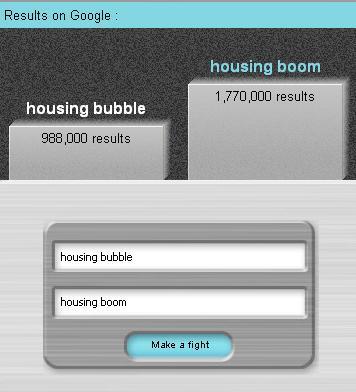
The term 'housing bubble' had 986,000 hits on Google whereas 'housing boom' had 1,770,000 hits. I'll continue to monitor these numbers as the housing bubble pops.
Wednesday, July 27, 2005
Real Estate Kiosks
At the local mall, there is a real estate kiosk. The company that runs them is called Realty USA which is based in Bethesda, MD (suburban, Washington DC). They have kiosks in many of the malls in the Washington area. Check out their online job application . I have not seen real estate kiosks until recently. Just a sign of the times.
Tuesday, July 26, 2005
Monday, July 25, 2005
WashingtonPost: DC RE Market Cools
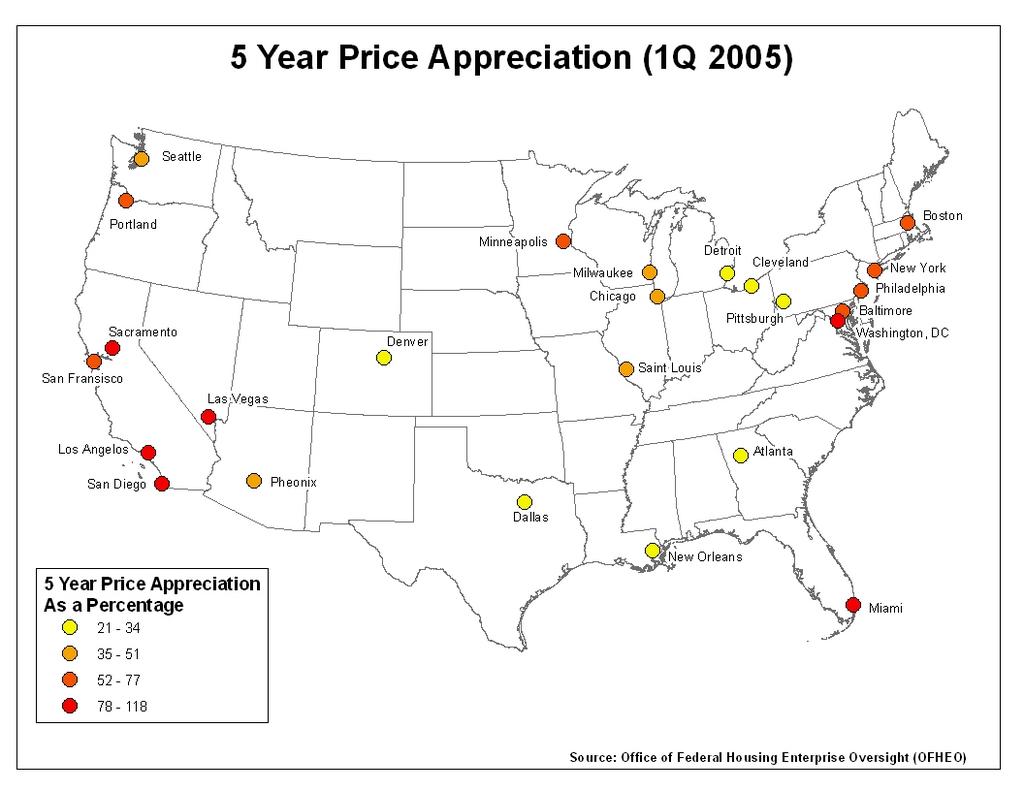
The Washington metro area housing market has seen rapid price appreciation of about 90% (OFHEO study) over the past 5 years. However, there has been strong fundamentals driving the market such as strong population growth, and strong job growth (lots of high paying jobs).
The market in the Washington, DC area is starting to stagnate. A reasonable argument can be made that DC prices may stagnate but it is not a bubble market because of the solid fundamentals. Here are some quotes from the Washington Post article:
Towards the end of the article:
The Washington, DC market is stagnating. If the Washington, DC housing market which has strong fundamentals is stagnating, then certainly there will be stagnation in bubble markets which do not have strong fundamentals. Look for stagnation in bubble cities such as Miami, Orlando, Los Angelos, Merced, Bakersfield and Reno. The price stagnation in these bubble cities will be followed by price declines.
The market in the Washington, DC area is starting to stagnate. A reasonable argument can be made that DC prices may stagnate but it is not a bubble market because of the solid fundamentals. Here are some quotes from the Washington Post article:
Home sales tend to slow in the summer, but the number of houses for sale in the Washington area has climbed by 50 percent in recent months. The available inventory has risen to about 35,300 homes, up from an average of about 23,000 in
the past three years, according to Metropolitan Regional Information Systems Inc., which runs the local multiple-listing service.
Local real estate brokers say they are seeing signs of a change."The market has slowed for sure, especially at the high end," said Wes Foster, chairman of Long & Foster Real Estate Inc.
Foster said the market is returning to "normalcy" after a frenzied era of multiple contracts, bidding wars and desperate buyers waiving their right to property inspections or appraisals.
It's very healthy," he said. "It worried the pure hell out of me the numbers we were seeing. I remember Boston in 1982 to 1989, when [prices] went up 25 percent a year for six years, and then in one year [they] fell 87 percent. The ride up for everybody selling was wonderful but the ride down was awful. . . . It was very painful and I don't want to see that here."
Foster said the recent manic market has been fueled by what he called "crazy fools running around buying houses as investments," with "bad loans, interest-free loans."
They'll get hurt, and I think they should," as prices inevitably correct themselves, he said. A slowdown is needed because so many average people have been priced out of homes or compelled to pay high prices, he said.
Towards the end of the article:
In Falls Church, Josefina Villegas, 71, thought her house would sell in just a few days when she put it on the market in late June and that she would soon be winging her way, carefree, to visit her grandchildren in Florida.
Houses in her woodsy neighborhood had been selling in the $900,000s, so she priced hers at $925,000 and waited for the bids to come in. She waited some more -- no bids. She dropped the price to $899,00. Three weeks later, still no bids.
I think houses are going slower now," she said, as she worried about getting the lawn mowed once again to keep up its pristine market-ready appearance. "Send
me somebody to buy."
Deborah Davenport, 50, listed her single-family house in Fairfax County last week at $569,000. Her husband, an echocardiographer who does heart ultrasounds, was offered his "dream job" with pediatric cardiologists in Tucson. In the past week, her home has been visited by just one set of prospective purchasers.
We haven't gotten any nibbles, unlike a month ago, when people put their houses on the market, and poof, they'd be gone," she said. "I figured it had to slow, it had to stabilize; but I hope it hasn't completely stalled -- for our sake."
The Washington, DC market is stagnating. If the Washington, DC housing market which has strong fundamentals is stagnating, then certainly there will be stagnation in bubble markets which do not have strong fundamentals. Look for stagnation in bubble cities such as Miami, Orlando, Los Angelos, Merced, Bakersfield and Reno. The price stagnation in these bubble cities will be followed by price declines.
Sunday, July 24, 2005
The HomeBuilders
One indication that there is housing bubble (in many markets) is to look at Home Builder's stock.
Now lets look at individual Homebuilder's stock:
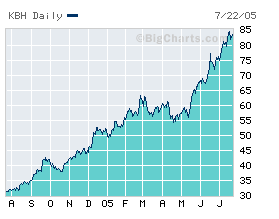
KB Homes (KBH) stock has almost tripled in value in the past year.
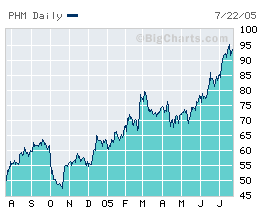
Pulte Corporation (PHM) stock has almost doubled in the past year.
It has gotten even worse, when I was discussing the real estate bubble earlier this year the Dow Jones Homebuilding Index was trading at nearly 800, it has increased over 30% in just a few months and trades at 1,070 as I write!! It has doubled in the last year. This, of course, is not sustainable. (HoweStreet.com, Dave Skarica)
Now lets look at individual Homebuilder's stock:
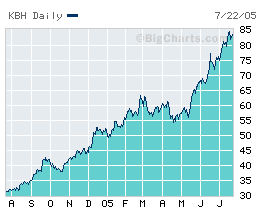
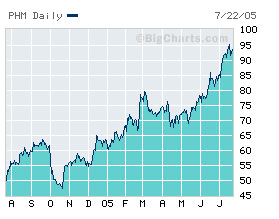
Is this sustainable? No. The housing bubble has caused a bubble in the stock value of Home Building companies. As the housing bubble bursts, the stock prices of these home builders will tumble.
Friday, July 22, 2005
Mortgage Rates Climbing
Mortgage Rates are increasing with "The average 30-year fixed rate mortgage inched higher from 5.76 percent to 5.78 percent, according to Bankrate.com's weekly national survey of large lenders. The 30-year fixed rate mortgages in this week's survey had an average of 0.38 discount and origination points. (July 21 /PRNewswire-FirstCall)"
As this blog has argued before, rising mortgage rates are NOT a necessity for a bubble bursting. However, rising mortgage rates are a nice prick that will help pop the bubble.
As this blog has argued before, rising mortgage rates are NOT a necessity for a bubble bursting. However, rising mortgage rates are a nice prick that will help pop the bubble.
Median Single Family House Price Map
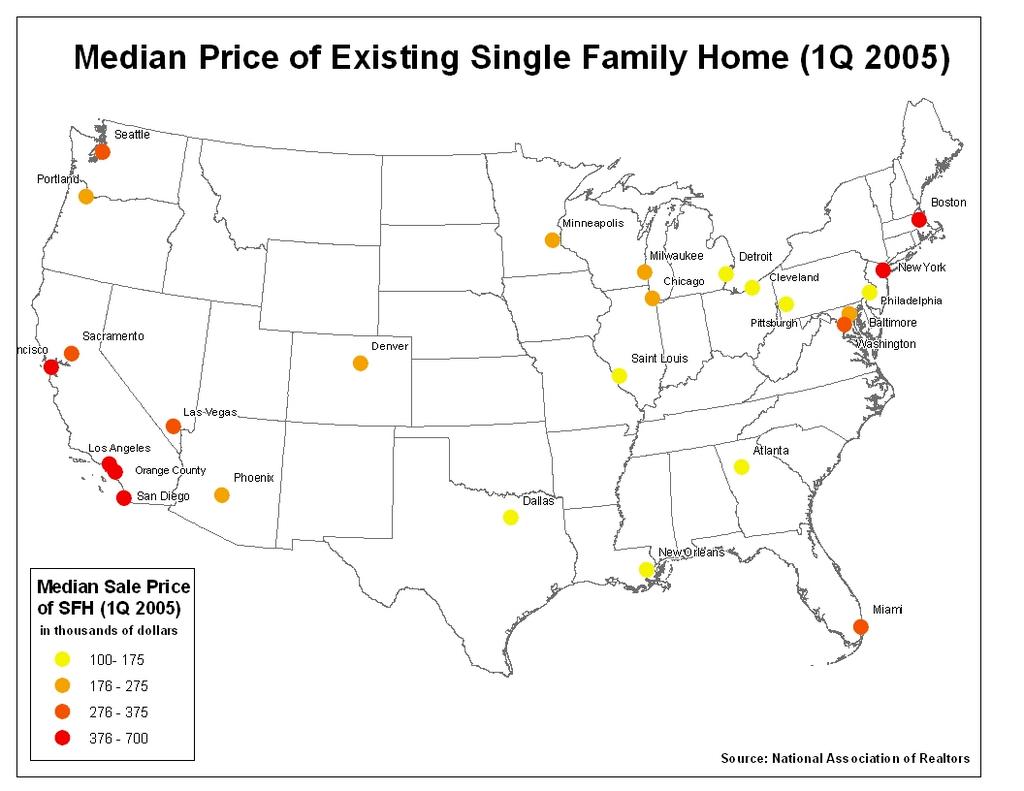
The above map shows the Median Single Family House Price in selected housing markets. You can click on the map to see the full image.
Thursday, July 21, 2005
Bubble Markets Stagnating
When the 'speculative fervor' ends in a real estate market it will inevitably lead to price stagnation followed by price declines. The rate of price appreciation slows, until prices are stagnating (appreciation is zero in inflation adjusted dollars). Then price declines set in. So which metropolitan areas are farthest along the cycle? Here are my candidates:
- San Diego: The year over year price appreciation (June 04 to June 05) is now a measly 6.3%. Most of that gain probably occured in the first part of that period
- Boston:
- Las Vegas
- Others ( please provide info)
Subscribe to:
Posts (Atom)

 Posts
Posts


