Bad news: According to S&P/Case-Shiller, month-over-month Washington, DC metro area seasonally-adjusted home prices rose 0.08% in April. Non-seasonally-adjusted home prices rose 0.8%.
For the Composite-20 average, seasonally-adjusted home prices fell 0.09%. Prices continued to fall in the four heavily-battered states of California, Florida, Nevada, and Arizona.
Inflation from March to April was 0.24%.
If Florida prices keep falling while DC prices start rising, I think I'm going to have to live where summer lasts all year long.
Tuesday, June 30, 2009

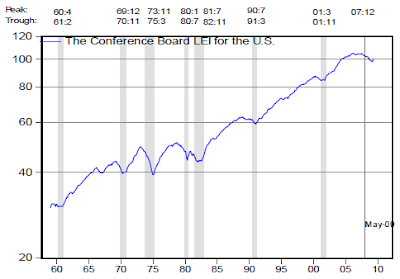
Leading Economic Index graph
The Conference Board Leading Economic Index attempts to forecast upcoming changes in the economy. Notice the slight uptick over the past two months.
 Economist and blogger Rebecca Wilder notes more signs of recovery here and here.
 Economist and blogger Rebecca Wilder notes more signs of recovery here and here.
Monday, June 29, 2009


Sunday, June 28, 2009
REDC runs wrong advertisement
 So, here I am on a cloudy Sunday afternoon assembling a new multimedia storage cabinet while flipping through the TV channels. I noticed one of those REDC home auction infomercials but was surprised when they mentioned a home in Stockton. "I didn't know there's an area called Stockton here in the Washington, DC metro area," I thought. The home being auctioned was actually in Stockton, California. I very quickly realized that all the homes in the infomercial were in Northern California. Apparently, REDC was accidentally airing a Northern California version of their infomercial here in the DC area. Oops!
I can't imagine many people in the DC area want to run out to a Northern California home auction. That looks like a half-hour's worth of advertising dollars wasted.
Update: REDC has been running the same Northern California ad on multiple channels, so either it's intentional (I can't imagine why) or someone really screwed up.
Thursday, June 25, 2009
In Support of Auditing the Federal Reserve
There are many great reasons to audit the Federal Reserve.
Ron Paul’s bill to audit the Federal Reserve (HR 1207) now has 242 co-sponsors, and the numbers keep growing! At the same time, HR 1207’s companion bill in the Senate, S 604, is beginning to attract its first co-sponsors,
Ron Paul’s bill to audit the Federal Reserve (HR 1207) now has 242 co-sponsors, and the numbers keep growing! At the same time, HR 1207’s companion bill in the Senate, S 604, is beginning to attract its first co-sponsors,
Wednesday, June 24, 2009
Housing decline likely causing lasting structural unemployment
Via Megan McArdle's blog:
Many Americans are mired in a housing gridlock: They can't afford to sell their homes because property values have fallen, causing millions of people to owe more on their homes than they are worth. And, many can't move to take new jobs until they sell their homes. ...Megan comments:
Fewer Americans are moving now than in any year since 1962, when the population was 120 million smaller.
"The economy is playing havoc, since property values have dropped significantly in the last few years," Hicks said. "Many people simply cannot just pick up and move. They have a home they have to sell first.
One of the justly celebrated strengths of the United States economy is its labor mobility. By this account, at least, our housing market has basically destroyed that critical asset. A recession like this is the worst time to lose your labor mobility.
Tuesday, June 23, 2009
Harvard on housing
From BusinessWeek:
Harvard University released its annual State of the Nation’s Housing report today. Among its conclusions: “Despite some stabilization in homebuilding and home sales in the spring, real home prices continued to fall and foreclosures mount in most areas in the first quarter of the 2009.”If I remember correctly, the Harvard Joint Center for Housing Studies was one of the bubble-blowers. Here's what they wrote two years ago:
Adds Eric S. Belsky, executive director of the Joint Center for Housing Studies at Harvard: “The best that can be said of the market is that house price corrections and steep cuts in housing production are creating the conditions that will lead to an eventual recovery.”
Together with the enormous increase in household wealth over the past 20 years, healthy income growth will help propel residential spending to new heights.The household wealth argument is a circular argument, because household wealth is strongly determined by housing prices and stock prices. As Rebecca Wilder recently pointed out, household wealth hasn't been doing so well recently.
Monday, June 22, 2009
MBA lowers mortgage expectations
From BusinessWeek:
The Mortgage Bankers Association today significantly lowered its 2009 mortgage origination forecast to $2.03 trillion, a drop of $700 million below its March projection. The primary reason: higher interest rates. Interest rates climbed from 5.19 on March 25 to 5.76 on June 17, according to Bankrate.com.
Rising interest rates have put a serious damper on refinancing.
Subscribe to:
Posts (Atom)

 Posts
Posts


